
 English
 Español
 Français
 Deutsch
 Italiano
 Português
 العربية
 Русский
 日本語
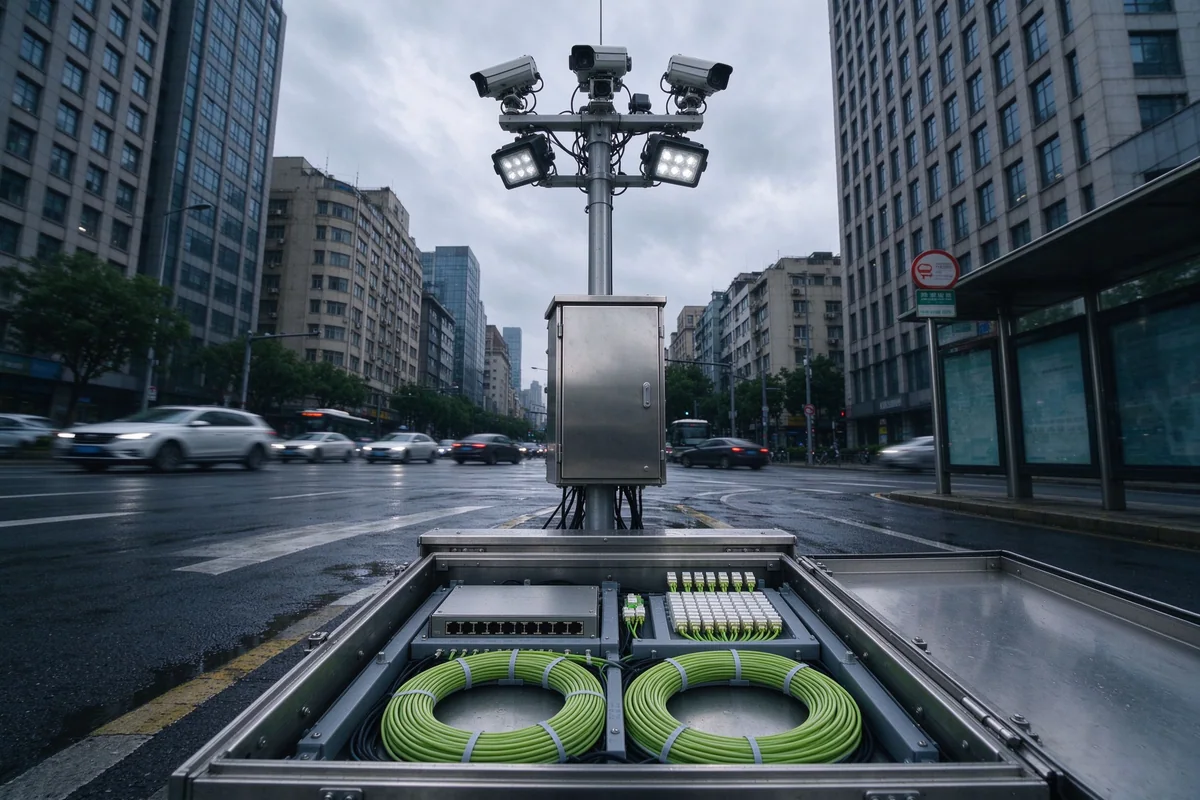
The need
The cameras were added over six years: some poles had their own small switch, some ran straight to the recorder, and a few shared a cabinet with the traffic signals. When a camera dropped, someone drove out to find it. Two intersections also needed ANPR cameras with higher power draw, and the recorder room wanted a single feed per cabinet instead of forty separate uplinks.
What was specified
| Model | Qty | Role in the project |
|---|---|---|
| RS1024K-P48-4S-10G-M | 6 | Intersection cabinet, 48 PoE ports for cameras and ANPR, 10G SFP into the ring |
| RS1025K-16LG-2S-10G | 2 | Recorder-room aggregation, sixteen ports, 10G SFP to each cabinet |
| RS1001KP-1S | 12 | PoE converter for isolated poles that carry one camera each |
Why that split
Forty-eight ports is the right size for a cabinet that serves a junction and its four approaches, and it leaves room for the ANPR additions without a second box. The recorder room gets one link per cabinet over 10G, which removes the forty separate uplinks and gives the ring a path around a failed span. Single-camera poles stay on a converter because a full switch there would be idle capacity and another device to power.
Result
- A camera that stops drawing power shows on the port, so the drive-out starts at the right cabinet.
- Each cabinet presents one link to the recorders instead of forty separate uplinks.
- ANPR cameras sit in the same cabinet as the junction cameras, on a separate VLAN.
Quantities in the table are the planned build, not a bill of materials for a specific tender.
