
 English
 Español
 Français
 Deutsch
 Italiano
 Português
 العربية
 Русский
 日本語
The need
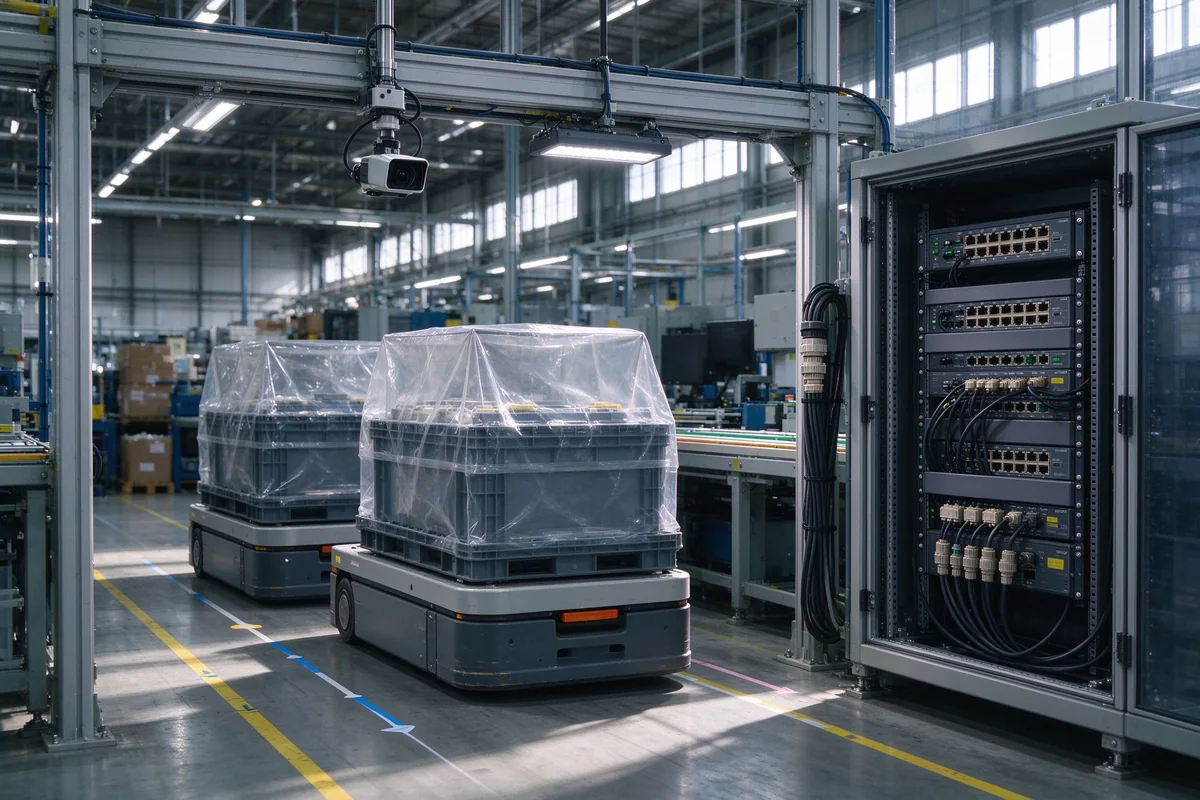
The weld shop is hotter and noisier than any office, and the AGVs have to keep talking to the fleet controller while the robots fire. Vision cameras at four assembly cells send full images to a server in the other hall, 180 m away, further than the existing copper could carry. Each cell had its own unmanaged switch, so faults were traced by walking the floor while the line stood still.
What was specified
| Model | Qty | Role in the project |
|---|---|---|
| RS1024K-P16-4S-MI | 6 | Managed industrial PoE in each cell: vision cameras, AGV access points, four fibre uplinks |
| RS1008K-8S-I | 4 | All-fibre concentrator per hall, joining the cells to the ring with no copper in between |
| RIS1000-16G-2F | 2 | Hall-level ring switch, two fibre links for redundant paths |
Why that split
Camera power sits in the cell, where the cameras are, so no extra supply goes in at each station. Fibre between cells and halls removes both the 100 m copper limit and the electrical noise the weld shop puts on long copper runs. One managed platform gives VLAN separation for AGV control, vision images and PLC traffic, and the ring recovers from a broken link without anyone walking the floor.
Result
- Faults are read at the ring switch instead of by walking the floor.
- AGV control and vision images are separated by VLAN but share the same switches.
- A new cell is added by patching into the hall concentrator.
Quantities in the table are the planned build, not a bill of materials for a specific tender.
