
 English
 Español
 Français
 Deutsch
 Italiano
 Português
 العربية
 Русский
 日本語
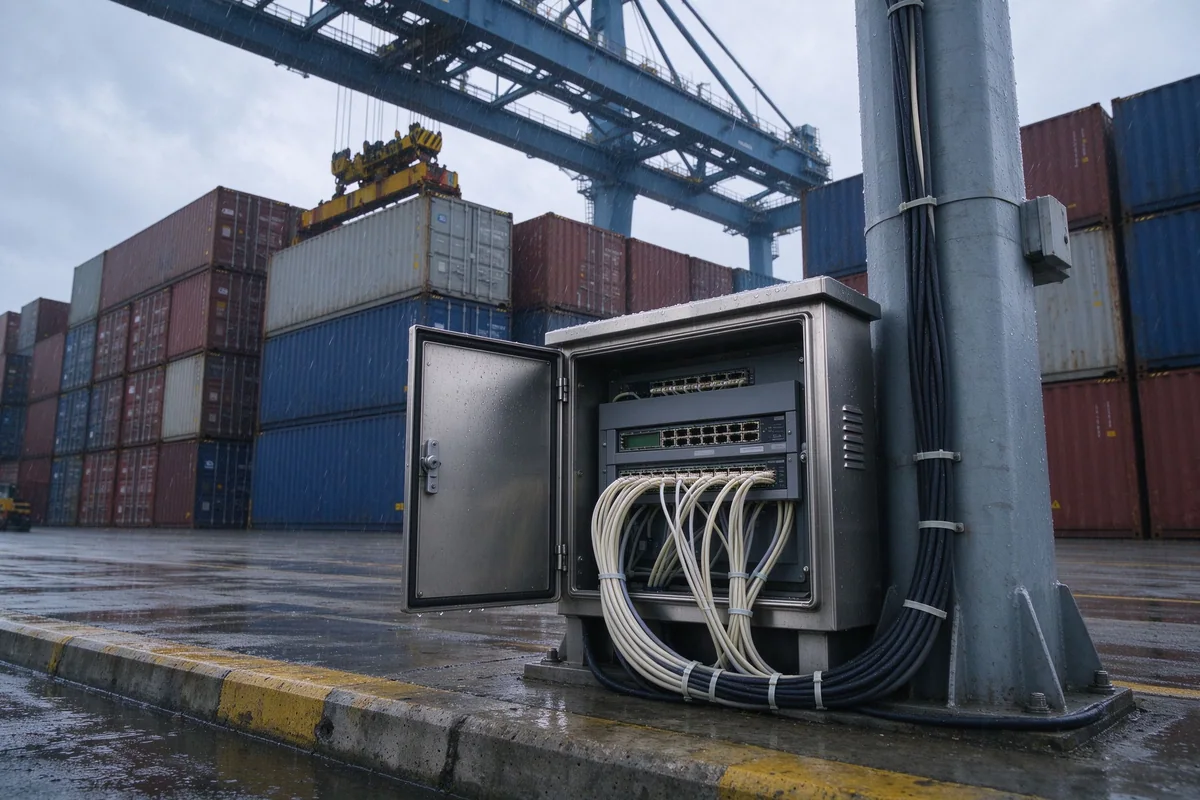
The need
The yard's 22 RTG positions each carried a terminal, a camera and a access-control reader. Positions are spread over 1.4 km, and the previous design chained copper switches between them, so one failure took out a group of cranes. The yard core needed a 40G path as lift counts grew.
What was specified
| Model | Qty | Role in the project |
|---|---|---|
| RS1025K-48LG-6S-40G | 4 | 48-port access per yard zone, 6 SFP+ and a 40G uplink to the core |
| RS1024K-24S-2S-40G-M | 2 | Yard aggregation, 40G backbone to the terminal operating system |
| RS1001G-1S | 18 | Fibre converters for the long zone-to-zone spans |
Why that split
Port density drove the access choice: a zone with 22 positions needs more than one 24-port switch, and a 48-port unit keeps the cabinet count down in a dusty environment. The 40G aggregation is the single point where the lift-count growth actually lands. Fibre between zones ends the chained-copper failure path that took out cranes together.
Result
- A zone failure is now local to that zone, not a group of cranes.
- Fewer cabinets in the yard, each with one uplink to manage.
- The 40G path gives the terminal system headroom without redesigning the access layer again.
Client and site are anonymised. The configuration is a reference design, not a quotation; zone counts, fibre spans and 40G capacity must be confirmed against the yard's own plan.
