
 English
 Español
 Français
 Deutsch
 Italiano
 Português
 العربية
 Русский
 日本語
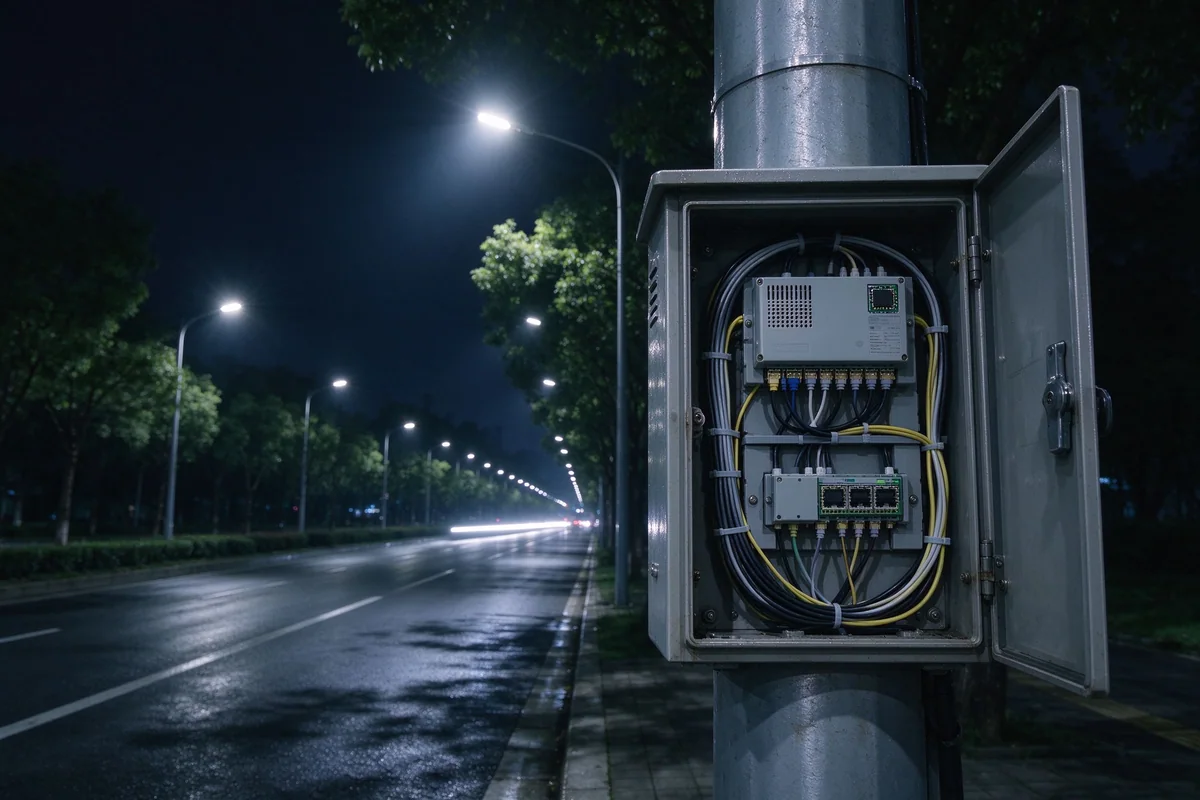
The need
The arterial crosses two districts and the cabinets are between 150 and 300 m apart, so the copper back to the depot could not carry both the lighting schedule and the junction cameras. A single cut took out a whole side of the road. The lighting team also wanted cameras at the two busy junctions without a second network, and dimming schedules change with the season.
What was specified
| Model | Qty | Role in the project |
|---|---|---|
| RIS2000-8GP-2FM | 6 | Pole cabinet PoE and fibre: lighting gateway, junction camera, two fibre ports into the ring |
| RS1008K-P8-4S-10G-M | 2 | Depot aggregation, managed PoE, 10G SFP uplink to the control room |
| RS1001KP-1S | 4 | PoE media converters for isolated poles where one camera sits alone |
Why that split
Fibre between cabinets removes the distance limit and the ring means one cut no longer blacks out half the road. PoE in the cabinet feeds the cameras without a separate supply at each pole, and the lighting gateway shares the switch instead of getting its own small unit. A managed platform lets the lighting schedule and camera traffic sit on separate VLANs while the depot sees link state per segment.
Result
- One cut is rerouted on the ring instead of taking out half the arterial.
- Seasonal dimming changes are pushed from the depot, segment by segment.
- Junction cameras ride the lighting network with no second cabling contract.
Quantities in the table are the planned build, not a bill of materials for a specific tender.
