
 English
 Español
 Français
 Deutsch
 Italiano
 Português
 العربية
 Русский
 日本語
The need
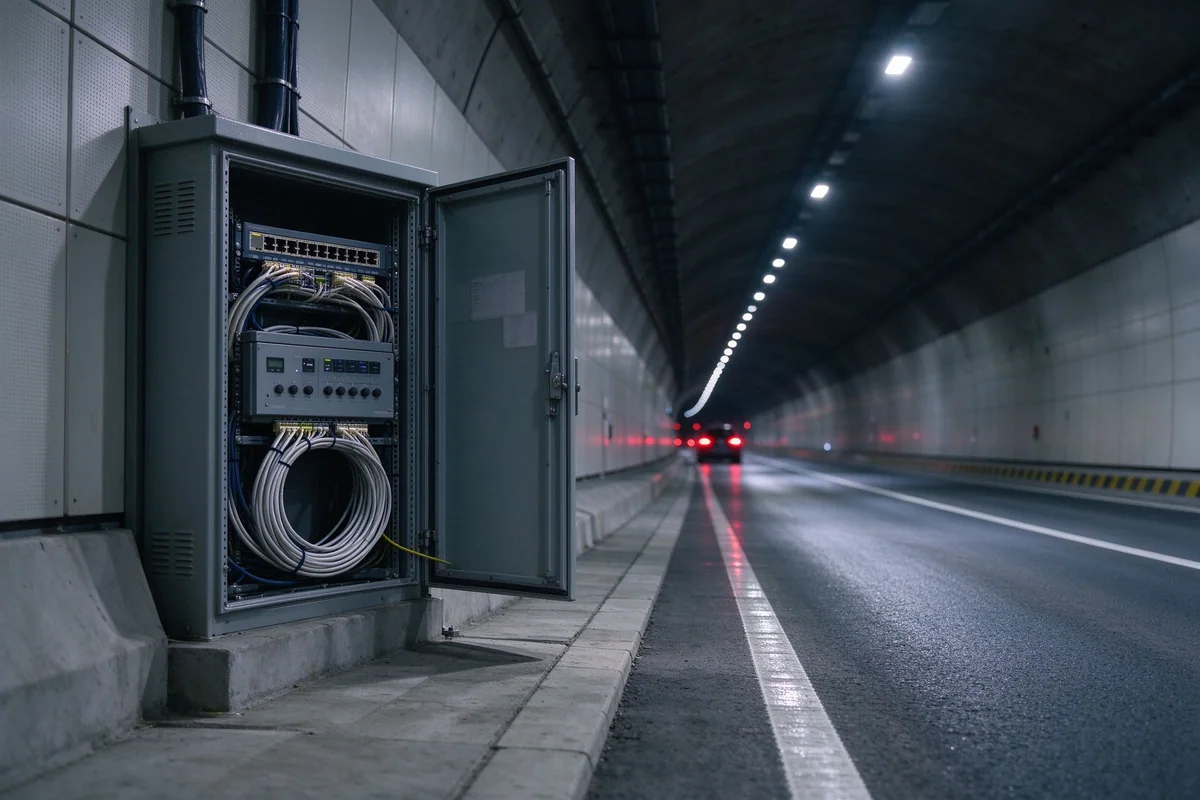
The tunnel has twelve lighting zones with luminance sensors at the portal and inside the bore, and the controllers sat in cross-passages where copper is not welcome: the drives put noise on it and the runs are long. One segment failure used to take the neighbouring zones with it, which is not acceptable in a bore with no daylight. Maintenance has to happen in short lane closures.
What was specified
| Model | Qty | Role in the project |
|---|---|---|
| RS1008K-8S-I | 4 | Cross-passage concentrator, eight fibre ports, joins segments without copper in the bore |
| RS1008K-2S-MI | 12 | Segment controller and luminance sensor, two fibre ports and managed remote access |
| RS1004K-2F-I | 2 | Portal cabinets at the entrance and exit, fibre to the control room |
Why that split
Fibre replaces copper in the bore because the drive noise and the distance both work against copper. Each segment keeps its own controller, so a fault is confined to that zone instead of walking down the chain. The concentrator turns twelve short links into one link to the control room, which is the part that has to survive a lane closure, and the portal cabinets keep the control-room side on the same platform.
Result
- A failed segment stays local; the rest of the bore keeps its dimming level.
- Portal luminance readings drive the zones without a separate sensor network.
- Work is done per cross-passage in short closures, not across the whole bore.
Quantities in the table are the planned build, not a bill of materials for a specific tender.
